With Connected Home in large-scale projects, Smart Living is scaled – including an interface for property management to ensure smooth operation.
In addition to networking building technology within the apartment, Connected Home in large-scale projects connects multiple apartments with the building technology of an entire development or area.
In the following article, we explain why Connected Home is not only interesting for residents, but also for developers, investors, owners, and property managers.
THE ESSENTIALS IN BRIEF:
The Smart Home was originally focused on improving quality of life through building automation systems and devices in apartments and detached houses. It was already considered a major step forward to be able to control lights and blinds from a single interface – either a wall panel or a smartphone.
The Connected Home in large-scale projects goes far beyond that. Not only are various systems now networked and react to one another—such as the heating, lighting, and blind systems, and the weather station. For example, if the sun is shining in winter and solar radiation on the windows is high, the blinds can be raised automatically and the heating turned down. In areas where the sunlight is disruptive, manual adjustments can be made by partially lowering the blinds again. In summer, however, if the indoor temperature is too high, the blinds lower, and if it becomes too dark, the lights are switched on.
In large developments or entire areas, Connected Home also ensures that multiple residential units are networked with each other, which simplifies building management. Among other things, Connected Home leads to better optimization of energy consumption, increased security for building access, and easier property operation for management.
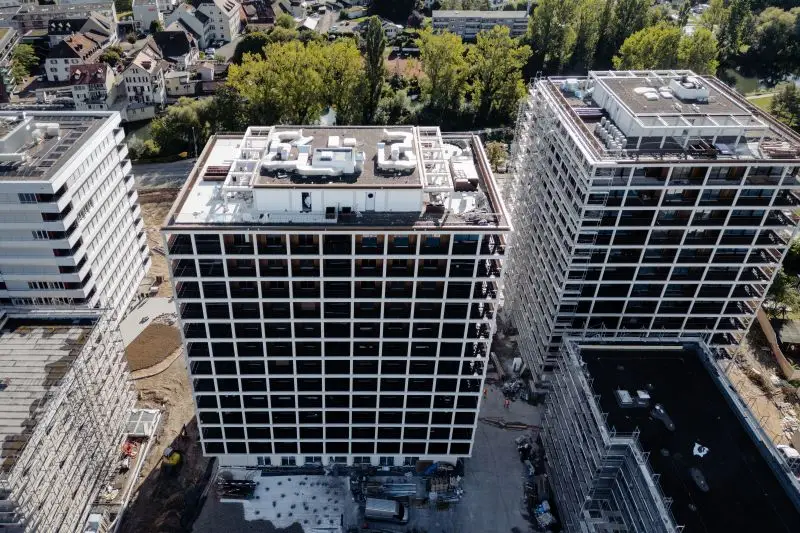
In particular, the challenge with Connected Home in large-scale projects lies in making the Smart Living infrastructure scalable so that the various systems can be consolidated across dozens or even hundreds of residential units. These systems, which are part of Smart Living today, include not only smart home solutions for lighting, heating, blinds, or ventilation, but also heat pumps, photovoltaic systems, charging stations for electric cars, and modern video intercom systems, as well as access control using chip technology.
Connected Home solutions are offered, for example, by Smart Home Swiss SA, including:
The Amika wall panel is compatible with various manufacturers, particularly the Connected Home solution from Wiser by Feller. There is an official partnership between Smart Home Swiss SA and Feller by Schneider Electric, which can look back on successful large-scale projects.
Thanks to the high degree of standardization, Connected Home solutions from Wiser by Feller and Smart Home Swiss SA can be installed and commissioned quickly. At the same time, it is guaranteed that individual apartments do not lose their unique character, as custom scenes and other personal settings can be configured.
There are many other benefits of Connected Home in large-scale projects, including the following:
"We chose a smart home solution because we wanted to offer residents optimal living comfort. At the same time, it was important to us to create more awareness of individual user behavior and resulting energy consumption."
Bauleiter Devin Kaiser von der HRS Real Estate AG
We at Smart Home Swiss SA would be happy to advise you on Connected Home for large-scale projects.
The best way to reach the Connected Home experts at Smart Home Swiss is via the contact form:
We will get back to you as soon as possible.
Connected Home in large-scale projects involves not only networking building technology within an apartment but also connecting multiple apartments with the building technology of an entire development or area, including an interface for property management for smooth operation.
Thanks to the high degree of standardization, commissioning Connected Home systems is much faster today than it was 5 years ago. However, the actual duration of commissioning depends heavily on the project size, system scope, and local conditions. Ideally, commissioning the Connected Home system takes about 45–60 minutes per apartment. For smaller projects, there is an additional 8 hours for general cloud setup and around 6 hours for network configuration.
However, these figures are guidelines that assume all systems are fully installed, configured, and ready for operation. If additional troubleshooting or problem-solving is required during commissioning, this can increase the effort.
A smartphone is tied to an individual. If a resident moves out, they take their smartphone with them, and the Connected Home controls would have to be completely set up again on the new resident’s smartphone.
With a fixed wall panel, however, the Connected Home control center remains in the apartment even when residents change. Only the username needs to be changed—for the doorbell, for example—which can also be done remotely by property management.
Other advantages of a fixed wall panel for Connected Home control include:
Nevertheless, in addition to the Amika wall panel, Smart Home Swiss SA also offers a smartphone app for controlling the Connected Home, as certain functions, such as light switches or blind controls, can then be used conveniently from the sofa or balcony. Furthermore, the smartphone app allows you to control the Connected Home while on the go, speak with visitors when they ring the doorbell, and even let them into the house remotely.
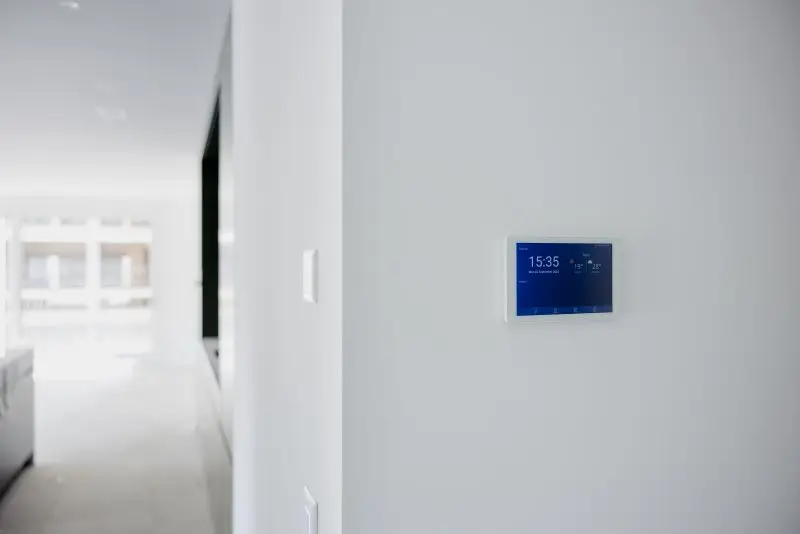
Amika is the all-in-one Smart Home control center from Smart Home Swiss SA, installed as a wall panel in the apartment to control building and home automation.
Energio is the data collector for smart metering from Smart Home Swiss SA and is used for real-time recording of consumption data from M-Bus energy meters, making Energio ideally suited for energy monitoring and optimizing energy consumption.
Porto is the IP video intercom system for modern buildings from Smart Home Swiss SA, featuring HD video and HD audio; as an outdoor station, Porto can be connected to the Amika touchscreen wall panel as an indoor station or to the “SmartHome Remote App” for mobile phones.