Smart Living goes far beyond simple smart home control via mobile phone.
In Smart Living, also known as Digital Living, several systems in the building are connected. Thanks to sensors, digital interfaces, and standards, these systems can react to each other automatically.
In the following article, we explain the advantages of Smart Living.
THE ESSENTIALS IN BRIEF:
Smart Living involves the networking of various building and house technology systems that react to one another.
Smart Living is only made possible by the proliferation of sensors, digital interfaces, and standards such as Wiser by Feller, KNX, or Z-Wave.
Smart Living specifically enables the optimization of energy consumption.
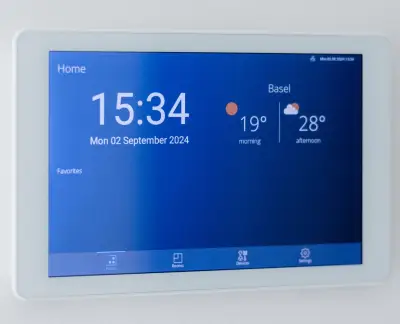
Thanks to modern smart home control, for example via the Amika wall panel, the complexity of Smart Living networks can be reduced through simple visualizations.
A wall panel for controlling Smart Living systems has many advantages over control via mobile phone.
Smart Living is a very recent achievement, as the various systems of building technology or house technology were previously not networked with each other. The electrician took care of the lighting alone, the heating was solely the responsibility of the heating installer, and the blinds were installed by the blind fitter.
Since the individual systems—lighting, heating, blinds, etc.—were usually analog, there was mostly no networking between these systems. There was also a lack of sensors, for example in living rooms or at a weather station, which are necessary to control blinds, lighting, and heating depending on sunlight and heat radiation.
Today, many rooms and devices not only have sensors, but the individual systems also have digital interfaces—including lighting, heating, blinds, heat pumps, photovoltaic systems, charging stations, or battery storage. Through standards such as Wiser by Feller, KNX, or Z-Wave, different devices and systems can be connected to each other.
If, for example, blinds and heating are to be coordinated today, blind fitters and heating engineers must work together on the construction site. The central link in the new Smart Living cosmos is the electrical installer, where all the threads come together.
Modern buildings today are no longer just smart, but can also handle energy more mindfully. Thanks to the networking of systems, ideal outputs can be achieved in each case, depending on how warm a room is, whether the sun is shining, how much electricity the PV system is currently producing, whether someone is present, etc.
The following optimizations of energy consumption are made possible by Smart Living:
Modern building control is highly complex. Thanks to the Smart Living solution with the Amika wall panel, smart home control remains clear. This is because the Amika panel translates complex technical relationships into a simple visualization, making them easy to understand:
A wall panel—such as the Amika touch panel—is more advantageous for smart home control than a mobile phone for several reasons. While a mobile phone is practical at first glance because it is mobile, you do not always carry it with you at home and then have to search for it when you want to use a specific smart home control function. The wall panel, on the other hand, is always in the same place, so it can be found at any time.
A further disadvantage of the smartphone: If the battery is empty, you first have to connect the phone to a power cable and sometimes wait a moment until the smartphone switches on again. The wall panel, however, is always supplied with power.
And with a mobile phone, you usually have to unlock the screen and open the right app before you can use it for smart home control. The Amika wall panel, on the other hand, can be operated at any time, and thanks to the larger screen, the visualizations of individual functions are also easier to recognize.
We at Smart Home Swiss SA would be happy to advise you on Smart Living and optimal smart home control.
The best way to reach the Smart Living experts at Smart Home Swiss is via the contact form:
We will get back to you as soon as possible.
The advantage of a permanently installed wall panel for smart home control is that it can always be found in the same place, whereas a smartphone can be misplaced. A wall panel is also permanently supplied with power. The screen on a wall panel is also larger than on a smartphone, which is why the visualization of individual functions is clearer.
A further disadvantage of a smartphone is that it usually has to be unlocked before it can be operated. Nevertheless, Smart Home Swiss SA, for example, offers a mobile app in addition to the Amika wall panel, which can even be used on the go to control your own smart home.
Smart Living essentially goes beyond simply controlling a smart home via an app. This is because Smart Living involves connecting various systems within a building—such as the heating system and the blind system. In this way, these systems can interact with one another and operate much more energy-efficiently.
A trade (Gewerk) refers to manual or structural work in the construction sector. Individual trades include, for example, electrical installation, solar installation, heating installation, sanitary installation, etc.
In bidirectional charging, an electric car functions not only as a power receiver but also as a power storage unit for receivers other than the electric car itself. With bidirectional charging, the electric car can, for example, supply power to the public power grid or the power grid of your own home.
In Switzerland, a ‘Store’ or ‘Storen’ is understood to be a roller shutter or an awning.